
Every guest at Dolan meets the Uyghur people before the first plate arrives — in the doppa caps on the wall, in the pot of floral tea poured before anything else, in a noodle pulled by hand that morning. Many of our guests had never heard the word "Uyghur" before they ate with us. This is who we are.
A Turkic people of Central Asia
The Uyghurs (pronounced WEE-gur) are a Turkic people whose homeland lies in the heart of Central Asia, where the Chinese world meets the Turkic one. Our language belongs to the same family as Turkish, Uzbek and Kazakh, and our culture grew where the trade routes of Asia crossed. Uyghurs are, for the most part, Sunni Muslims, and the rhythm of daily life — the greeting, the meal, the welcome of a guest — carries that faith lightly and warmly. The name is an old one: a Uyghur kingdom ruled the steppe in the eighth and ninth centuries, and its people later made the oasis cities of Kashgar and Turpan centers of Turkic learning.
The homeland
Imagine the snow-capped mountains, winding rivers and blue-green lakes that have long been home to the Uyghur people. The Uyghur homeland — known to Uyghurs as East Turkistan and administered today as the Xinjiang Uyghur Autonomous Region of China — is a land of extremes. At its center lies the Taklamakan, one of the largest sand deserts on earth. Around it stand three great ranges: the Tian Shan, the "Heavenly Mountains," to the north; the Pamirs, the roof of the world, to the west; and the Kunlun to the south. Their snowmelt feeds the Tarim, Yarkand and Ili rivers and fills lakes of an almost unreal color — Karakul in the Pamirs, Sayram in the Ili valley.
Where the rivers reach the desert's edge, oasis cities have flourished for two thousand years: Kashgar, with its Sunday market and old town of mud-brick lanes; Turpan, one of the lowest and hottest places in Asia, where underground karez channels water vineyards famous for raisins; Hotan, home of jade and silk; and Ghulja, in the green Ili valley of lavender fields and grasslands, where our founder, Hamid Kerim, grew up. The Dolan tribe for whom our restaurants are named lived in the oases along the Tarim and Yarkand rivers.
Through all of it ran the Silk Road: caravans skirting the desert carried silk, paper, spices and ideas between China, Persia, India and the Mediterranean, and the Uyghur oases were where they stopped to trade, rest and eat.
Language and script
Uyghur is written today in an Arabic-based alphabet adapted to Turkic sounds, with Latin forms common in the diaspora. Centuries earlier the Uyghurs wrote in their own vertical script, later adopted for Mongolian. In our logo, the word Dolan is set in a flowing script of a different kind — drawn with noodles.
Music, gatherings and craft
Uyghur culture sings. The muqam — twelve great suites of song, poetry and dance passed down for centuries and recognized by UNESCO as a treasure of humanity — is played on the long-necked dutar and tambur, the plucked rawap, the bowed satar and the frame drum called dap. The meshrep is the gathering where that music lives: neighbors and families seated on carpets, sharing food, song and poetry late into the night. Ghazi Ehmet's painting Muqam, which hangs in our dining rooms, shows such a circle of musicians.
Uyghur hands are known for their crafts, too: the embroidered doppa cap whose almond — badam — pattern is the heart of our logo; the shimmering atlas silk of Hotan and Kashgar; knotted carpets; copper and clay teapots. Hospitality is the greatest craft of all: a guest is seated in the place of honor, tea is poured before any question is asked, and the cloth spread for a meal is never left empty. Bread is sacred; a Uyghur will never set a naan face down.
A living cuisine
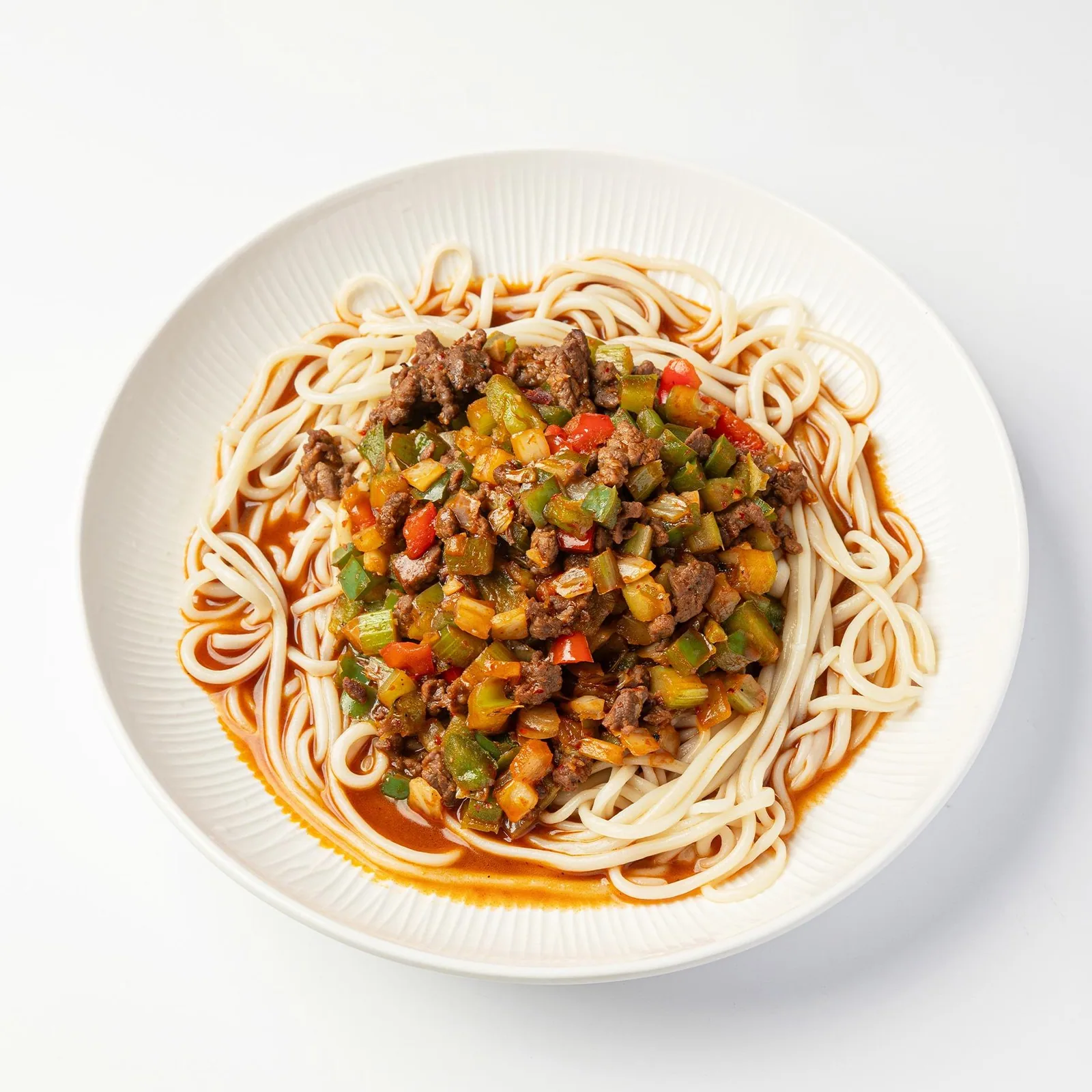
Food is where Uyghur culture is most alive, and it is what Dolan was founded to share. Laghman — noodles stretched by hand into long, chewy strands, served with stir-fried lamb, peppers and tomatoes — is the national dish; our Korma Chop is its fried cousin. Polo, rice cooked in broth with carrots, onions and lamb and finished with golden raisins, is the dish of weddings and family gatherings. Samsa, baked in a tandoor, and steamed manta carry the same spiced lamb and onion in two doughs. Kebabs dusted with cumin come off the charcoal on long skewers; Big Plate Chicken arrives on a platter meant for the whole table; round naan is baked against the tandoor's walls. The meal ends, as it began, with tea — the floral Gül Chai we blend ourselves.
The Uyghurs abroad, and Dolan's place among them
Uyghur communities live today across Central Asia, in Turkey and Europe, in Australia and North America. The Washington, DC area is home to one of the largest Uyghur communities in the United States — which is why a family from Ghulja could open a Uyghur restaurant in Cleveland Park in 2018 and find both a homesick community and a curious city at the door.
That is Dolan's place in the story: five dining rooms where Uyghurs taste home and our neighbors discover a culture most have never encountered — one bowl of laghman, one pot of tea, one shared platter at a time. Discover the culture. Count memories.